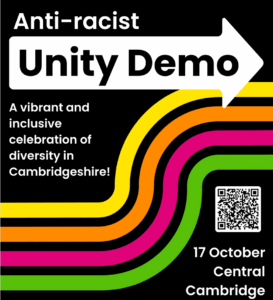
There was an important march and demonstration in Cambridge on Saturday 17th October calling for equality, solidarity and an inclusive society.
I was really sorry that I couldn’t attend as I was out of the country, but I am grateful to Cllr Sarah Haithcock for reading out my speech at the event.
Notes from Cllr Katie Thornburrow
[I’m sorry I can’t be with you today to express my support in person]
Good morning, everyone. Thank you all for being here today.
I’m a city councillor, the leader of the council, and a campaigner for food justice and water security. But I’m speaking not just because of my position, but to express my opposition to racism, to stand in solidarity, and to speak out for our wonderful diverse county and city.
I am a woman of colour who arrived in the UK from Hong Kong as an 18-year-old and was welcomed into this community. Having grown up abroad in a colony, coming here showed me that there are special aspects of life in the UK, in Cambridgeshire, and right here in Cambridge that we must hold dear. I built my life here, found friends and support and love, and have always valued the differences and diversity of views, cultures, backgrounds, and beliefs I found. They are what makes us special. They are what makes us stronger.
Cambridge is a place where everyone should be able to make their home. It starts with the values we set: building a caring, supportive society where we look out for one another from our youngest to our oldest, and especially those in need. Those of us in positions of responsibility, whether as teachers, parents, workers, or councillors, have a duty to treat others as we wish to be treated, and to push back against the forces that seek to divide us. We need to use our influence to do good, and not allow division to thrive.
We often quote Jo Cox’s famous words: “We have more in common than that which divides us.” But as we reflect on that message, we must also recognise that having more in common does not mean we are all identical. We are not all the same, and we shouldn’t be. We come from different cultures, have different needs, and hold diverse values and aspirations. We do not have to agree, we do not have to share every point of view, but we absolutely need to be tolerant and understanding.
Our strength comes from embracing our diversity accepting that our differences are precisely what make our community vibrant and resilient. I don’t want us all to be alike; each one of you brings something unique and special to this city.
At a time when division and conflict seem to be everywhere, events like today are a way of offering hope, and that seems vitally important to me. When we stand together, respecting each other’s individuality while united in our common humanity, we build a stronger Cambridge for everyone.
Thank you.
