Joining the dots between water, food, and a growing city

Each month I write a column for the Cambridge Independent (online here but it will ask you to acccept coookies or pay) that’s also published on the City Council website.

However I believe in a principle known as POSSE, which stands for Publish (on your) Own Site, Syndicate Elsewhere. You never know when someone else’s site will go away or add a paywall, so it’s worth having your own copy, under your control.

So here it is.


As the leader of Cambridge City Council, I often find myself reflecting on the issues that keep us up at night, not just as politicians, but as neighbours, parents, and members of a vibrant, interconnected community. And the recent hot weather, which has made it hard to sleep for many of us, has given me lots of time to consider the connections between climate change and two of the issues which got me into local politics in the first place – water and food.

Before I became a councillor I studied food policy and campaigned for food security. In 2024 the council’s support for the Cambridge Sustainable Food Partnership helped the city obtain a Gold Award from Sustainable Food Places, recognising Cambridge as leading the way in transforming local food systems to better serve our communities, the environment and the local economy.

However, it was always clear that water supplies in Cambridge were limited and precious, and the needs of farmers, developers and residents sometimes came into conflict. In 2019 I organised awater crisis forum with experts and local people to talk about the wider issues of how to get enough water to support the city as it developed, and the use of water for farming was one of the issues we discussed.

Continue reading “Joining the dots between water, food, and a growing city”

The future of Market Square

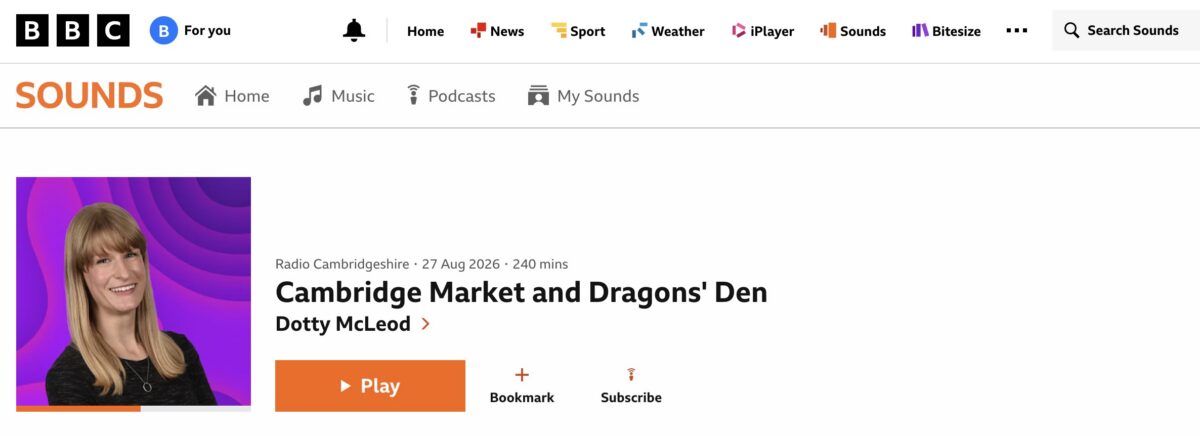
I was on BBC Radio Cambridgeshire with Dotty McLeod this morning, where I was joined by long-standing market trader Zoe Hardinge to talk about the future of the market, as a planning application is coming to the planning committee next Wednesday.

I know how important the market is to Cambridge, and go there regularly myself. In thinking about its future we want to preserve its vibrant, colourful character of our market while ensuring our stallholders can trade there successfully for years to come. We also want to make sure that the market square itself is a great civic space for everyone, especially in evenings when the market isn’t operating.

During our conversation, Zoe highlighted several practical concerns from experienced traders, particularly around future rent structures and the proposed balance between fixed, open, and demountable stalls. I agreed with her that traders need clarity on these rates so they can plan ahead with confidence. Retaining our existing stallholders and helping them run successful, profitable businesses remains central to our vision, which is why we’re putting in special arrangements to relocate stalls while the work is being carried out.

To make the square fit for modern use, we are also delivering essential background infrastructure. We are upgrading water supplies, drainage, and power across all stalls, replacing the current uneven surfaces with a single level floor for improved accessibility, and moving commercial bins underground to create a cleaner, more hygienic environment. Environmental sustainability is embedded throughout the design, featuring insulated roofs and solar panels on fixed stalls, green roofs on semi-permanent stalls, new tree planting along the northern edge, and the full restoration of the plumbing of the central fountain.

And the layout of the market stalls themselves will adapt as needs change. If future demand shows we need a different proportion of open or demountable space, we have the flexibility to adjust.

Beyond daily trading, Market Square is the civic heart of Cambridge, sitting directly in front of the Guildhall. By using stalls that can be put aside during quieter winter months or special events, we can create an adaptable, welcoming space for wider community gatherings while ensuring permanent traders continue to operate seamlessly year-round. Our ultimate goal is to create a safe, bustling, and beautiful civic space that honours our heritage, supports local businesses, and serves everyone in our community.

Listen here – scroll forward to 2:07:45

“The Soul of Chinese Music”

On Saturday I was at a fabulous concert of Chinese music held in Trinity College Chapel as part of the extensive Cambridge Chinese Music & Culture festival, which is co-hosted by the Cambridge Qin Society, Cambridge University Chinese Orchestra Society and Cambridge Chinese Community Centre.

The concert lived up to its name, The Soul of Chinese Music, and it was a real pleasure to hear the wide variety of musical styles, played on instruments from the guqin, the ehru and the yangqin to the piano and flute, and I especially enjoyed the Guqin Ensemble’s performances.

My good friend and former councillor and mayor Dinah Pounds and her husband Adam were also there to perform, with a beautiful meditation on passing time composed by Adam also on the programme.

Continue reading ““The Soul of Chinese Music””

Remembering Jason Arday

This evening there was a vigil to remember Jason Arday, who died on Friday after being hounded by the press and online attackers and was forced to resign his Professorship at Cambridge University.
I am away from Cambridge and couldn’t be there, and I’m grateful to my colleague and friend Councillor Rosy Moore for reading some words on my behalf.

Like every one of my fellow councillors I am shocked and profoundly saddened by the death of Dr Jason Arday. We send our condolences to his family, friends and colleagues.

As a community we will grieve his death and try to learn from what has happened. Nobody should face the pressure Jason was put under, particularly by the excessive, racially-motivated and cruel press coverage. And there are serious questions to answer for the organisations that had a duty of care towards Jason, and whether they did enough to protect him.

We know that much of the coverage was motivated by an attempt to destroy the career of an exceptional black man, and we must not allow those who tormented him to hide behind false protestations of shock or sadness.

Like many of you, I am left wondering what we have lost now that his voice is absent from the academic debate about race and inclusion, and that he will no longer be heard by the Runnymede Trust, the British Sociological Association and the many other places where he brought his insights and expertise. While we grieve Jason’s death today, we also remember and celebrate his legacy.

Thank you

Talking toilets

If you watch yesterday evening’s Look East on BBC iPlayer then there’s a report on the new Silver Street toilets from Mousumi Bakshi where I’m interviewed (it starts at 17:15 if you scroll forward)

It was good to see that the bat box and squat toilets appeared, because I’m very pleased that we have an inclusive space that also supports nature, but I can understand why there’s a focus in the cost, and going from ‘spending a penny’ to spending a pound makes a great headline.

However if we want to keep our toilets clean, safe and well-maintained we have to pay for it. Providing public toilets isn’t a statutory duty for local authorities – though the British Toilets Association has a “Legalise Loos” campaign to change that – and so we have to balance the costs with all the other things the council needs to do.

Some public toilets are free, like those in Lion Yard, and we felt that £1 was a reasonable cost in a place where a lot of visitors to Cambridge are passing. As one person says in the interview, in other European countries paying €1 or €2 for the loo isn’t unusual. We will review the costs regularly.

We are also going to make sure that the signs on the toilet make it a bit clearer that you need to go downstairs, and that the ground floor is the disabled toilet.

You can also read about it on the BBC News website in Phil Shepka’s story or in my blog post from last week. There is also coverage on the City Council website.

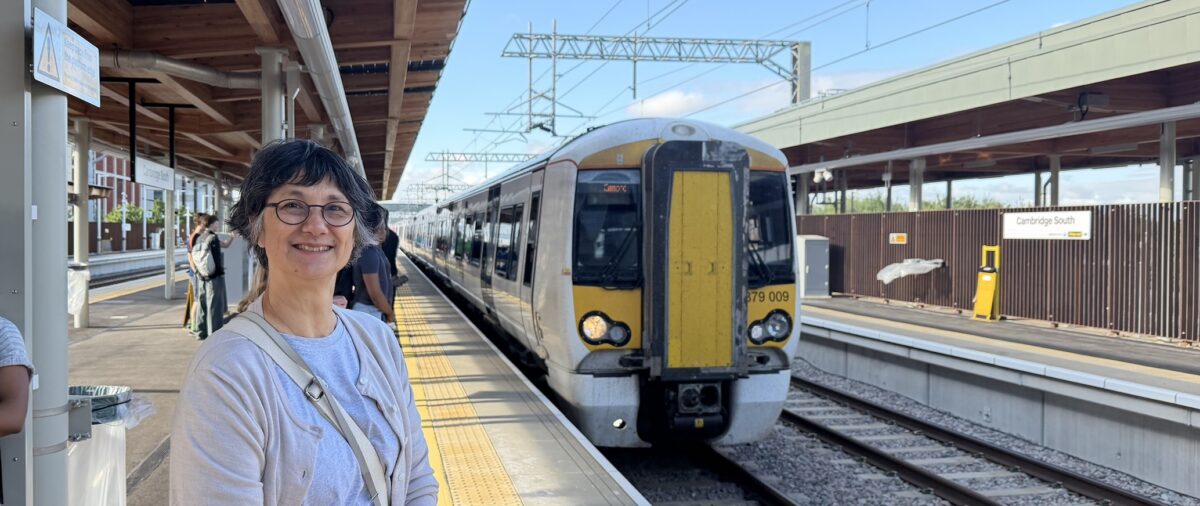
Cambridge South: a special station

One of the best things about the new station is that is has been designed to be sustainable, to enhance local biodiversity, and to use modern building materials, working to the BREEAM standards – that’s the Building Research Establishment Environmental Assessment Method, the world’s leading sustainability assessment and certification method for masterplanning, infrastructure, and buildings.

Hear Katie explain why she thinks the new station is special

And read the government’s press release with more detail. As they say the station is

Designed to blend in with its surroundings, the station integrates with the existing Hobson’s Park nature reserve, helping to protect valuable green space, recreational areas and wildlife habitats.

Its ‘green roof’ includes a wildflower meadow environment and a rainwater catchment system that will store and slowly discharge rainwater back into the environment and the nearby brook, while the station’s overall design and construction efficiencies have reduced the station’s carbon footprint by over 22%.

Let’s work together for Cambridge

At the Council AGM on May 21st no Leader was chosen and as a result there are no Cabinet members and all committee seats are vacant. We will reconvene as a Council on June 1 to resolve this. It is an unwelcome situation that has arisen because the other parties would not support me as Leader but were unwilling to put any other candidate forward or to propose a solution.
This is what I said at the end of the meeting. I call on the other parties to put the interests of Cambridge first and resolve things. They know where to reach me.

Here is the transcript of what I said:

Maria Cleminson: Councillor Thornburrow.

Katie Thornburrow: I have worked with Tim Bick and many of his members, very collaboratively and very successfully, and with enjoyment. I’ve also worked with Naomi Bennett, and Jean [Glasberg], and Hugh [Clough], with enjoyment, and we’ve been a really good council collectively. I have gone out of my way to work with green issues across the city.

And we need to get on and make make a decision about a leader. It may be that Tim could put his name forward, or you, Naomi.

We have put our case about our leader. We are prepared to be in opposition and we would still work constructively and collaboratively, and we would do everything possible for the best um, the needs of the council and our residents.

We have not said that we wouldn’t work with you in that way. And if you were to put your name forward today, and if that was the democratic decision going forward, we would then go and talk about the scrutiny committees and we would enable the council to get on.

We are prepared to work. We have a proposal about a way to work, you can propose a way. We feel that one of us could be a leader, and we will respect the democratic decision of of the councillors in this chamber.

Our proposal has not been accepted, I’d really value proposals from you. If we were in opposition, we would be constructive and collaborative. We would continue to work in our wards, and we would continue to do what we could for the council and the greater good.

Maria Cleminson: Thank you, Councillor Thornburrow

How will we feed ourselves?

Last Wednesday, January 21, the Council Chamber in Cambridge Guildhall was filled with a group of people brought together to consider one of the most important questions facing us today: how do we feed ourselves? They were joined online by others as part of a series of public conversations about the main challenges and opportunities that Cambridge faces under the theme “How Resilient is Cambridge?”

The meeting was convened through a partnership between Cambridge City Council, the Resilience Web (resilienceweb.org.uk) and the Cambridge Room (cambridgeroom.org), and marked the end of a process that started in July 2022 when I made a commitment in a City Council meeting commitment to find a way to “explore the resilience of the city to the climate emergency in a series of open consultations.” I knew that something like this takes planning, organisation and support and I am grateful that the Cambridge Room and Resilience Web were able to provide all three.

It was the first in a series where we will be talking about several aspects of resilience, including flooding, energy, and communications, but I’m pleased that we started with food security because it was thinking about this that led me to become a city councillor in the first place.

Continue reading “How will we feed ourselves?”

Talking About Mill Road

The bus gate on Mill Road bridge continues to be one of the main topics people raise with me as a ward councillor for Petersfield, which includes the western half of the road. As a councillor, I’m committed to listening to all points of view and trying to help us all find a way forward that brings the community together.

So last night I attended a meeting at the Mill Road community centre organised by the group Cambridgeshire ACTION, whose website states that they are ‘a non-party political, grass-roots movement of citizens from across Cambridgeshire’ created for people with ‘concerns about the unfair, undemocratic and unwelcome decision making by the various tiers of local authority and other unelected decision-making bodies in Cambridgeshire.’

In the past they have campaigned against the closure of the bridge and promoted protests against what they call ‘this ridiculous plan to discriminate against all vehicles,’ so they are not a neutral body. However I felt it was crucial to be there to listen and to share what I know about the bridge closure. And the meeting was convened to discuss not just those concerns, but also the potential opportunities for Mill Road.

The room was full, with about 70 people present. It was a real mix of the community – residents, local shopkeepers, and organisations like Living Streets. I was there alongside my colleagues City Councillor Dave Baigent from Romsey and the new County Councillor for Romsey, Darren Green.

Continue reading “Talking About Mill Road”

A budget to welcome

I took some time out this afternoon to watch Rachel Reeves deliver her first budget, and as well as the sheer joy of seeing a Labour budget presented by our  first Labour Chancellor, there was a lot to welcome.

I was really pleased to see compensation for those who have been waiting years for justice over the scandals around contaminated blood products and the Post Office Horizon computing system, along with funding to enable the removal of the sort of unsafe building cladding that led to the horror of Grenfell.  

And we finally have a Covid Corruption Commission, and we may finally find out just how so much public money was wasted on failed health measures and unsuitable protective equipment.

Continue reading “A budget to welcome”