“Let’s Talk About” – the Greater Cambridge Development Corporation


On the evening of March 4 I took part in a public discussion about the government’s consultation on establishing a Development Corporation for Greater Cambridge, organised by the Cambridge Room, of which I am proud to be a Trustee.

We were joined by Peter Freeman and Beth Dugdale from the Cambridge Growth Company and Cllr Dr Tumi Hawkins from South Cambs District Council. Also on the panel was Eleanor Riley from The Ministry of Housing, Communities and Local Government who talked through government context and details of the consultation.

Each of us was given a chance to outline our views, and these are the speaking notes I used – though I may have said something slightly different on the night.

The consultation on the Development Corporation runs until the end of the month and I urge you to read the papers and make your own contribution. And perhaps my notes will be helpful.

Notes towards a talk

Thank you all for being here. Today, I want to share my thoughts on the proposed development corporation (devco), and I have three main points to make: one is a common-sense point about democracy, one is a practical concern about the planning service drawn from my own experience, and the third is a more radical proposal for the future of Greater Cambridge, because the challenge today is not just acknowledging the devco and the government’s ambitions, but defining how we use it to deliver our wider objectives rather than just “business as usual” expansion.

First, we must address the democratic deficit that is too easily built into a centrally-led Urban Development Corporation. The government’s proposal relies on a top-down model where the board is appointed by the Secretary of State. While the proposal invites local council leaders and the combined authority mayor to sit on this board, having a few seats at the table is simply not enough for true democratic integration. To meet our challenges, the board must also include specific expertise in ecological resilience, local food policy, circular economics, and community or youth engagement.

Continue reading ““Let’s Talk About” – the Greater Cambridge Development Corporation”
Food policy in the Labour manifesto

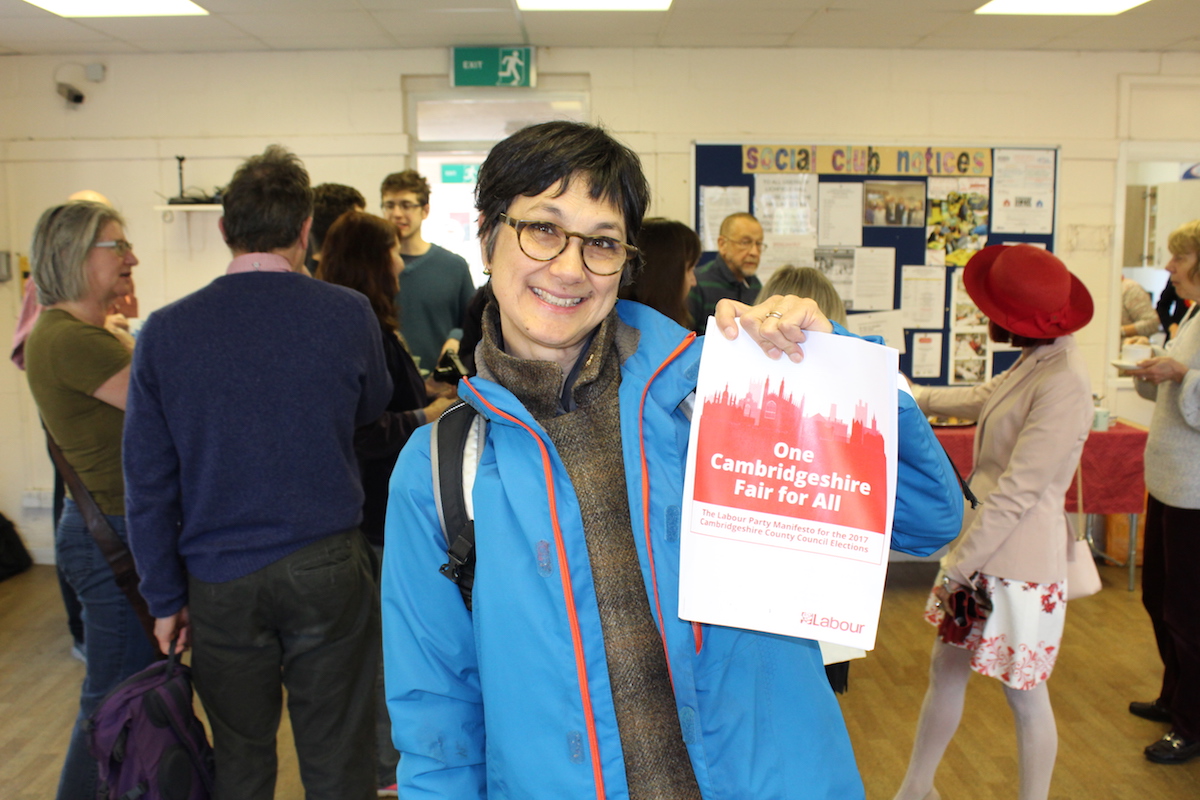
There are many good things in the just-launched 2017 Cambridgeshire County Council Manifesto and you can read them all on the Labour group website.

However the one area I’m most excited about is the section on Environment and Climate Change, which I helped on.  It’s a great statement of what Labour could do with a stronger voice on the County Council.

It says:

Environmental concerns and dealing with climate change are at the top of the Labour Party’s agenda, illustrated by our support for reduced car use and better public transport, energy efficiency throughout the county’s properties and a reduction in the county’s carbon footprint. We will pursue sustainable green policies throughout the County Council. We will pioneer plans to cut emissions from buses and taxis.

One-third of Cambridgeshire is below sea level and the County Council’s refusal to take the risk of climate change seriously threatens property and livelihoods across the county. Labour will support a comprehensive strategy for the management of flooding and draught conditions across the county. We believe in renewable energy and we will encourage organic practices throughout the County Council’s extensive farms estate.

A Labour County Council would:

  • Develop a climate change strategy which aims to make Cambridgeshire a zero-net carbon county by 2050. To lead the way, we would reduce emissions from our own estate and property portfolio and work with partner organisations across Cambridgeshire to cut carbon emissions. We would invest further in green energy using council income and applying for national grants to reduce the county’s carbon footprint.
  • Divest the County Council’s substantial pensions and investments fund from fossil fuels. This would make the County Council fossil fuel free and a model for other public sector as well as private sector organisations.
  • Work with residents, businesses and other organisations to reduce vehicle emissions across Cambridgeshire. We would work with coach, bus and taxi operators to seek funding for transformational reductions in diesel emissions to improve public health.
  • Provide high quality green infrastructure. We would use all opportunities offered by planning, the City Deal and other projects to achieve green public spaces. This includes planting more trees and ensuring that new developments provide the open space and recreational facilities that residents need.
  • Promote energy-saving schemes by building on the collective energy switching policy to use the collective power of Cambridgeshire residents to negotiate cheaper energy prices. We would improve promotion and advertising and create a private sector energy officer to improve information, publicity and uptake of energy and insulation schemes such as the Green Deal and the Energy Companies Obligation.
  • Develop a new food nutrition, production and security policy. This would develop the principles of the previous Labour government’s ‘Food 2030’ strategy which was abolished by the coalition government. Our policy would prioritise reducing the number of people in food poverty as well as those suffering from malnutrition and obesity due to changes in food processes and diets. It would also ensure that everyone in Cambridgeshire is ‘food literate’ in the same manner that local authorities are attempting to increase online literacy. We would provide guidance and best practice information for food producers. We would review the provision of school meals and ensure they are sustainably sourced with good educational initiatives for children.